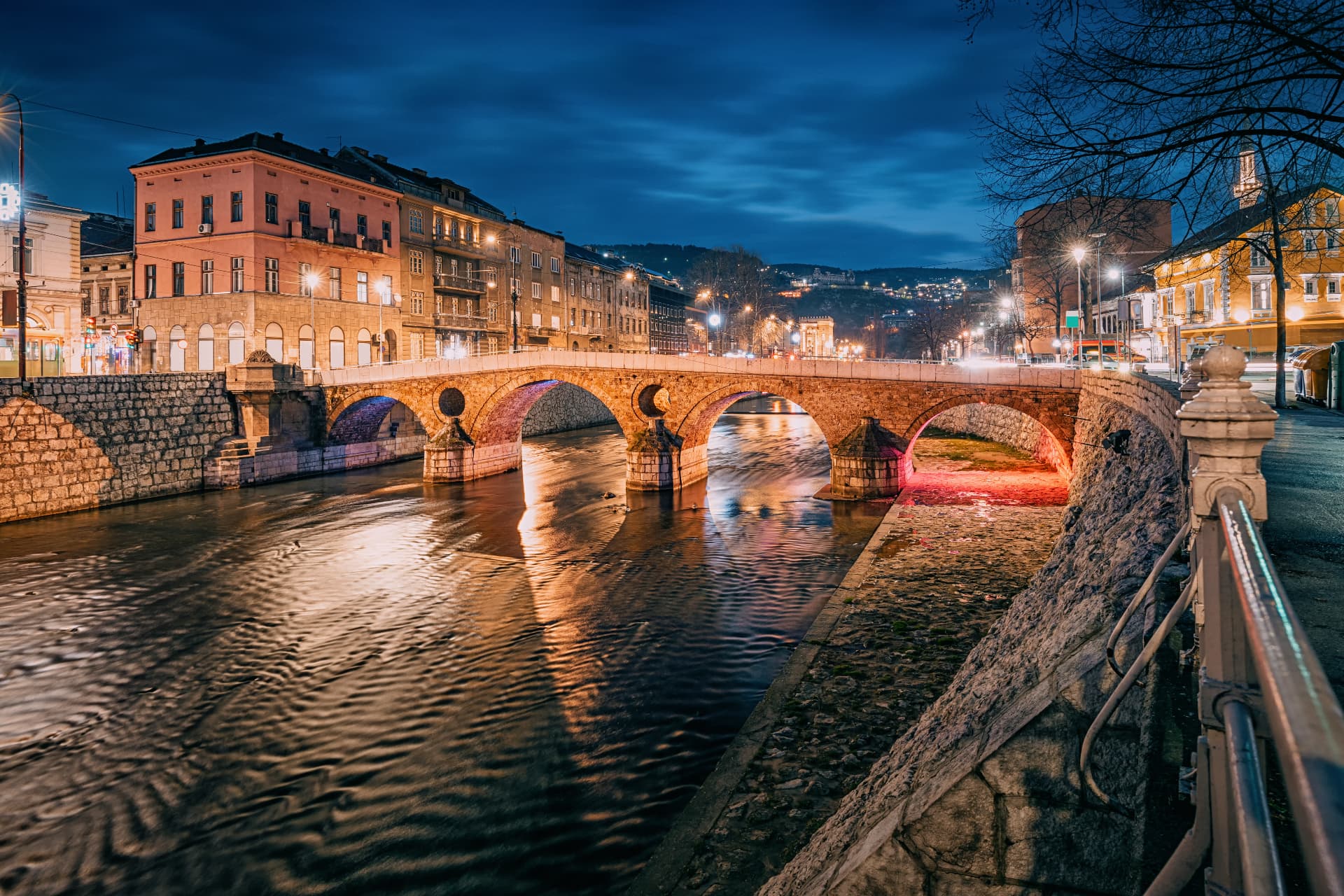
A City in a Bowl
There are cities whose geography explains something about their history. In Sarajevo, it is almost impossible to separate the two.
The city follows the Miljacka River through a long valley, hemmed in by steep, wooded hills and mountains. From the streets below, they are beautiful. Houses climb the slopes in improbable tiers. Minarets and church towers rise from the city beneath them.
But stand in Sarajevo long enough and another thought intrudes.
You are standing in a bowl.
For almost four years, from 1992 to 1996, that geography became a weapon. Bosnian Serb forces occupied much of the commanding ground around Sarajevo, from which artillery, mortars and snipers could fire into the city below.
It is difficult to comprehend that history when walking through Sarajevo today.
Because what struck me most was not conflict.
It was peace.
Not peace in the grand diplomatic sense. Bosnia and Herzegovina still carries political and constitutional tensions. The architecture created to hold the country together remains complicated, contested and unfinished. The wider Balkans cannot yet be treated as a settled strategic space.
Indeed, I had come to Sarajevo for a security conference at which Bosnia's future and Europe's changing security environment were very much under discussion.
But at street level there was something simpler.
People were drinking coffee.
Restaurants were busy. Young people moved through the streets. Shopkeepers stood in doorways. Families wandered through Baščaršija. The call to prayer travelled across the rooftops, and people came and went from the mosques with remarkably little ceremony.
Sarajevo seemed comfortable being alive.
That should not be taken lightly in a city where, within living memory, simply crossing a street could get you killed.
Where East Meets West
Walk through Sarajevo and the city changes before your eyes.
Baščaršija retains the scale and texture of the Ottoman city: narrow streets, small shops, courtyards, fountains, copperware, cafés and minarets. The Gazi Husrev-beg Mosque, dating from the sixteenth century, remains one of the defining buildings of the old city.
Islamic life is not hidden away. It belongs to the streetscape.
Sarajevo today is Muslim-majority, and Islam is unmistakably part of its public character. Yet what interested me was less the number of mosques than their relationship with the life around them.
They did not appear detached from the city behind gates or empty except at prescribed hours. There was movement through them: people arriving, leaving, meeting, talking.
They seemed not merely places to which a community went to worship but places around which community happened.
And immediately alongside this Ottoman inheritance comes another Sarajevo.
Walk west and the streets broaden. The architecture becomes unmistakably Central European. The Austro-Hungarian city announces itself in stone façades, civic buildings and avenues.
The transition can occur within a few minutes' walk.
There is even a point on Ferhadija where the change in architectural character is visible almost beneath one's feet: Ottoman Sarajevo behind you, Austro-Hungarian Sarajevo ahead.
East meets West without either entirely disappearing.
Christianity and Judaism are written into the city too. Mosque, Catholic cathedral, Orthodox church and synagogue stand within an unusually small area of central Sarajevo, contributing to its old description as a kind of European Jerusalem.
That inheritance should not be romanticised. Sarajevo's history gives ample warning against easy stories of inevitable coexistence.
But neither should it be overlooked.
Sarajevo has known what coexistence looks like.
It also knows how quickly it can be lost.
A Street Corner That Changed the World
Then there is a bridge.
Or, more precisely, a street corner beside one.
The Latin Bridge is commonly associated with the beginning of the First World War, although the assassination itself occurred beside it.
On 28 June 1914, Archduke Franz Ferdinand, heir to the Austro-Hungarian throne, and his wife Sophie were assassinated by Gavrilo Princip near the bridge over the Miljacka.
It is a surprisingly ordinary place for an event of such consequence.
That may be precisely why it matters.
Within weeks, an assassination on a Sarajevo street had activated alliances, mobilisations, grievances and calculations extending far beyond Bosnia. Austria-Hungary declared war on Serbia. Europe descended into war. Empires collapsed. Borders moved. Revolutions followed. The political map of much of the world was redrawn.
Today, traffic passes. Pedestrians cross the bridge. Visitors stop for photographs.
And the city continues around them.
History does not always announce the significance of a place while it is happening.
That is worth remembering in Sarajevo.
It is worth remembering elsewhere too.
Buildings That Remember
Sarajevo's buildings tell its story almost as clearly as its monuments.
Look carefully and the scars of the 1990s remain.
Bullet and shell damage can still be seen on buildings around the city. Elsewhere, the memory has been preserved deliberately in the pavement through the Sarajevo Roses — mortar impact scars marking places where civilians were killed, some filled with red resin.
The effect is powerful precisely because Sarajevo has not been frozen around them.
People walk across history on their way to work.
Children pass it on their way to school.
Coffee is served a few streets away.
Memory and ordinary life occupy the same city.
Perhaps the most extraordinary example is Vijećnica — Sarajevo City Hall.
Opened in 1896 under Austro-Hungarian rule, its richly ornamented Neo-Moorish architecture is itself an expression of Sarajevo's layered identity: a European imperial government choosing an architectural vocabulary drawn from the Islamic world for one of the city's most prominent civic buildings.
By the late twentieth century, Vijećnica housed the National and University Library of Bosnia and Herzegovina.
Then came 1992.
During the siege, the building was shelled and burned. Its interior was devastated and an enormous collection of books, manuscripts, journals and archival material was destroyed.
It was eventually reconstructed and reopened in 2014.
In September 2026, it was one of the principal venues of the Sarajevo Security Conference.
There is something worth considering in that progression.
A building erected under one empire; inherited by subsequent states; transformed into a library; burned during another European war; painstakingly reconstructed; and now filled with Bosnians, Americans and Europeans discussing how to prevent future conflict.
Buildings can carry memory without becoming prisoners of it.
The Hall — and the Reminder
Another conference venue told a quieter and, for me, more personal version of Sarajevo's story.
The Dom Oružanih snaga Bosne i Hercegovine — the Armed Forces Hall of Bosnia and Herzegovina — began life during the Austro-Hungarian period as an officers' casino. It acquired much of its present appearance in the years before the First World War and, across successive political orders, became not only a military building but a place for concerts, exhibitions, lectures and civic gatherings.
Today it belongs to the Armed Forces of Bosnia and Herzegovina.
It was there, on the Sunday morning of the Sarajevo Security Conference, that I delivered my keynote on confidence-building.
The history and significance of the room were not lost on me.
Before me sat generals and diplomats, military officers and policymakers — an audience bristling with medals, credentials and accumulated experience of the institutions created to preserve European and transatlantic security.
Yet Sarajevo is not a city in which those institutions can be discussed only in the abstract.
So I offered what I intended not as a rebuke, but as a reminder.
We failed here in 1995.
By “we,” I meant the international structures and institutions that emerged from the post-war determination that Europe should never again descend into such darkness.
The United Nations had designated Srebrenica a “safe area.”
Yet in July 1995, Bosnian Serb forces overran it. As the enclave fell, some 4,000 to 5,000 people were admitted to the compound of the Dutch United Nations battalion at Potočari, while an estimated 15,000 to 20,000 remained outside in its immediate vicinity.
Elsewhere, a column of up to 15,000 people — predominantly men, and including both civilians and members of the Army of the Republic of Bosnia and Herzegovina — set out through forested and partly mined territory towards Tuzla. Many were captured or surrendered after coming under attack.
Bosnian Serb forces separated men and boys from those gathered at Potočari and systematically executed prisoners from both Potočari and the column. More than 8,000 people were killed.
International courts determined that the crimes committed at Srebrenica constituted genocide.
That history makes institutional language sound different in Bosnia.
Words such as security, deterrence, protection and international order acquire weight when spoken in a country where people were promised protection and discovered, at the moment of greatest need, the distance that can exist between a promise and the capacity — or will — to honour it.
My argument that morning was not that the institutions themselves were worthless.
Quite the opposite.
Institutions matter enormously.
Alliances matter.
Diplomacy matters.
Military capability matters.
But none can live indefinitely upon their founding achievements.
They must earn confidence.
And sometimes that requires those of us who believe in them to acknowledge where they have failed.
There was something particularly striking about making that argument inside the Armed Forces Hall.
Bosnia and Herzegovina is itself evidence that institutions can be rebuilt. A country whose peoples fought one another within living memory now possesses common armed forces under a single state-level structure.
That does not erase Bosnia's divisions. Nor does it settle its political arguments.
But it is something tangible.
Perhaps that Sunday morning the building was quietly making the same argument as the speech:
Peace requires institutions. But institutions require more than architecture, mandates and impressive titles. They require the confidence of the people they exist to protect.
The Hills
And then I left Sarajevo.
My journey to Srebrenica took me upwards, through and beyond the neighbourhoods climbing the slopes around the city.
From there, Sarajevo looks different.
Looking down into the valley, it becomes possible to understand physically what otherwise remains an historical fact.
During the siege, forces positioned on those heights could look directly into the city.
Driving those roads today, through trees, houses and ordinary morning life, it does not take much imagination to remove thirty years.
A bend in the road.
A clearing.
A view across the valley.
And suddenly the peaceful city below looks terribly exposed.
I found that profoundly moving.
The streets in which I had watched people drink coffee, shop, pray and talk were now beneath me. The geography had not changed. Only what people were choosing to do with it had changed.
Perhaps that is one of the things Sarajevo can teach those of us who spend our lives thinking about security.
Geography does not change simply because politics does.
Mountains that shelter can also dominate.
Roads that connect can be closed.
Neighbours can become enemies.
Institutions that appear permanent can fracture with astonishing speed.
And promises made in conference rooms eventually have to survive contact with events.
But Sarajevo offers the reverse lesson too.
Cities can survive.
Vijećnica can burn and be rebuilt.
A street once watched by a sniper can again fill with café tables.
A mosque can call people to prayer while, a few streets away, bells sound from a church.
An officers' hall inherited from an empire that disappeared more than a century ago can become the Armed Forces Hall of a new country and host a conversation about preserving its peace.
And a generation after men looked down from these hills through gun sights, a visitor can travel through them toward Srebrenica and look back upon a city remarkably at peace.
Not a peace that should ever be taken for granted.
Perhaps that is the point.
Sarajevo does not allow the visitor the luxury of believing that peace is permanent.
But neither does it permit the conclusion that conflict is inevitable.
Both are built.