Edition I · The Principal Long Read
The Atlantic Archipelago
A Strategic Compact for an Unsettled Age
By Mark J. Finlay FRICS · Edition I · 24 September 2026
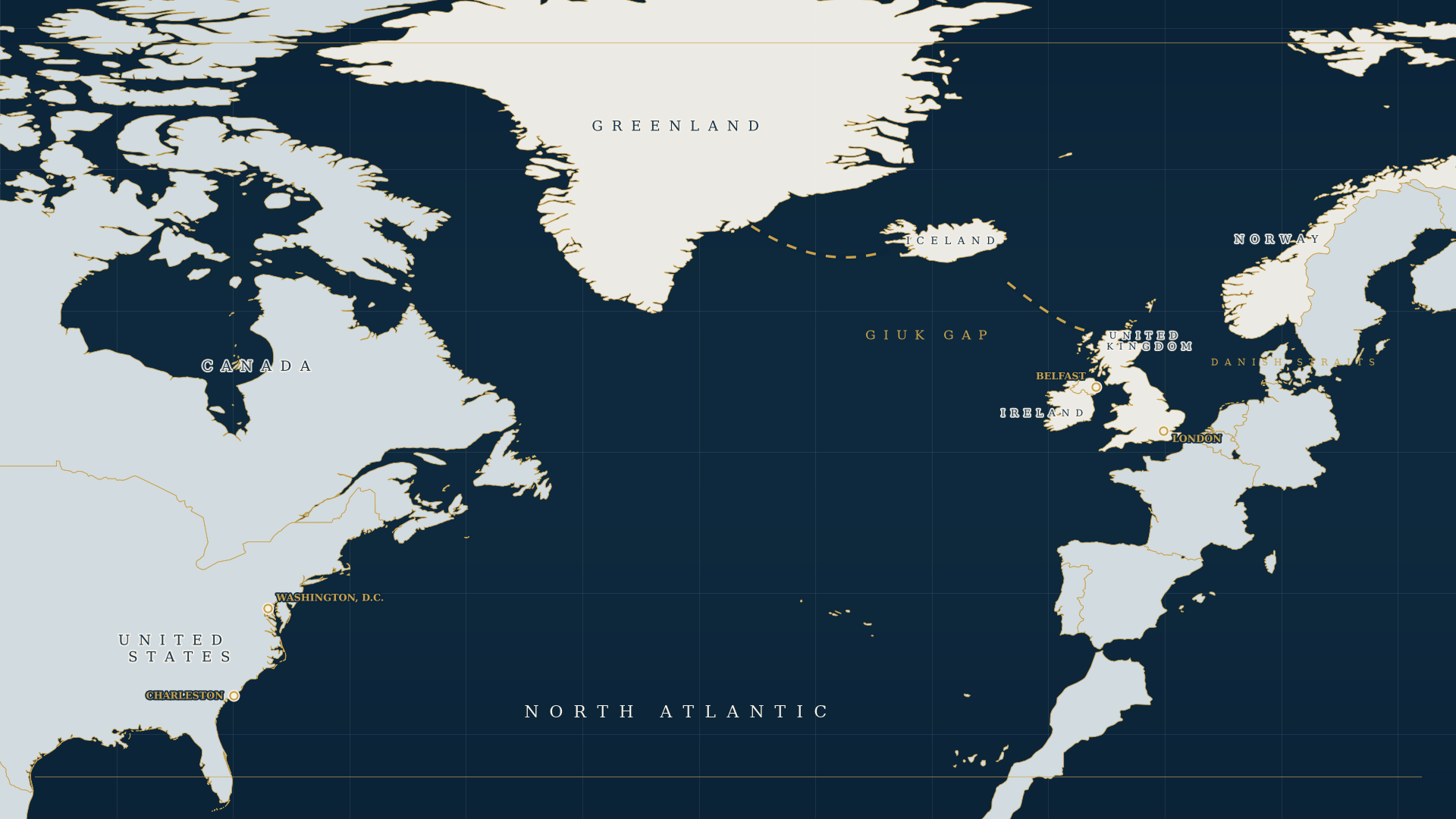
The constitutional future of the British Isles is again being contested. Their strategic geography is not.
Change elsewhere has always caused people to reconsider arrangements closer to home. During the Atlantic revolutionary age, ideas crossed borders and oceans almost as readily as armies and merchant ships. The American Revolution influenced France; France helped ignite Haiti; and the repercussions spread into Ireland, Europe and Latin America. Political movements learn from one another—and moments of upheaval give old ambitions new confidence.
That does not mean constitutional change across these islands is inevitable, or even desired by most of their people. Many remain content with the constitutional settlement while being deeply dissatisfied with the state of government, public services or society. Those are not the same thing. But the renewed coordination among nationalist parties in Scotland, Wales and Northern Ireland shows that constitutional arguments once treated separately are increasingly being presented as part of a common cause.
Whatever becomes of that cause, the strategic facts will remain. These islands still guard the approaches between continental Europe, the Arctic and North America. They still sit across the maritime routes through which trade, energy, data, military power—and danger—must pass.
Yet geography and responsibility have not been equally matched. The Republic of Ireland occupies the western approaches to Europe, possesses a vast maritime domain and hosts subsea cables upon which much of the transatlantic economy depends. Nevertheless, it has maintained only a limited capacity to monitor, patrol or defend that space. Ireland may be militarily non-aligned, but the waters and airspace surrounding it are not somehow rendered neutral. In practice, the security from which the Republic benefits is upheld principally by the United Kingdom, the United States and their NATO allies.
The dependency is not theoretical. At the end of August 2026, Dublin reportedly requested a Royal Navy warship to provide air-defence cover while European defence ministers met in County Wicklow. Because of the legal and political constraints surrounding Irish neutrality, the vessel was expected to remain beyond Ireland’s territorial waters—even while helping to protect Irish airspace. A French frigate had provided comparable support during earlier meetings connected with Ireland’s EU Presidency. These were sensible acts of cooperation; they were also unusually clear demonstrations of the capability Ireland does not possess for itself.
Dublin has begun to acknowledge the gap. Its first National Maritime Security Strategy, new radar programme and planned regeneration of the Naval Service are welcome. But they also expose how long the problem was allowed to persist. Neutrality need not mean passivity; still less should it become a respectable name for allowing neighbouring countries to carry the burden.
It is against this strategic background that the renewed constitutional pressure—and the attempt to coordinate it across national boundaries—must be understood. In Cardiff on 14 September, the leaders of Plaid Cymru, the Scottish National Party and Sinn Féin gathered to affirm the right of Wales, Scotland and Northern Ireland to seek constitutional change.
Michelle O’Neill attended amid a dispute over whether she did so as Sinn Féin vice-president or as Northern Ireland’s First Minister. The distinction was convenient, but it was not trivial: Northern Ireland’s Executive rests on a joint office, and one holder cannot turn a party declaration into settled government policy.
The summit followed President Donald Trump’s remarks in Ireland in favour of Irish unity. His words pleased republicans, irritated unionists and drew attention once again to the consent provisions of the Belfast Agreement. They also revealed a larger truth. Questions once treated as settled—where sovereignty lies, which institutions command loyalty and how the nations around the North Atlantic relate to one another—are again open to argument.
We should not answer those questions with nostalgia. Nor should we pretend that constitutional disruption would leave defence, trade and infrastructure untouched. A Scottish vote for independence, a border poll on the island of Ireland or a further transfer of power to Cardiff would be decided by the people entitled to decide it. Yet each outcome would alter the political ownership of assets that serve a much wider strategic space.
The right response is neither to suppress constitutional debate nor to wait until a referendum campaign forces hurried answers. It is to build a framework sturdy enough to survive different constitutional outcomes.
I call that framework the Atlantic Archipelago.
Geography has already voted
The Atlantic Archipelago is not a new name for the British Isles, still less an attempt to smuggle one constitutional preference into a geographic label. It describes a connected strategic system: the United States and Canada facing east; Greenland, Iceland and the Faroe Islands across the northern ocean; Great Britain and the island of Ireland at Europe’s Atlantic edge. The nations and territories within it have different constitutions, alliances and identities. The water joins what politics divides.
Long before modern borders, Dál Riata linked north-eastern Ireland with Argyll and the western seaboard of Scotland. It was a maritime kingdom because the sea was a road rather than a wall. People, goods, belief and power moved between coasts. The surviving record is incomplete and should not be pressed into service for a modern political cause, but the underlying lesson remains sound. Communities around these waters have always depended upon movement and mutual support.
Today the cargo is different. Energy, food, manufactured goods and data travel beside naval vessels and fishing fleets. The seabed carries cables on which governments, markets and households depend. Ports act as commercial gateways in peacetime and strategic infrastructure in crisis. An interruption off Ireland, Scotland, Iceland or Greenland can be felt in London, Brussels, Washington and far beyond.
Our institutions, however, divide this connected space into separate files. NATO considers collective defence. The European Union governs much of the trade and regulatory environment. The Joint Expeditionary Force brings together northern European military partners. The British-Irish Council provides a political forum across these islands. The United States and United Kingdom have their Atlantic Declaration and AUKUS. Ireland remains militarily neutral while working with NATO through Partnership for Peace and drawing closer to Britain and other neighbours on maritime security. Each arrangement is useful. None treats the northern Atlantic as a single strategic system in which defence, trade, ports, energy and data meet.
“The water joins what politics divides.”
The Greenland–Iceland–United Kingdom Gap is the clearest place to see the strategic importance of the Atlantic Archipelago. Russian naval power enters the Atlantic from two distinct but connected theatres. The Northern Fleet deploys from bases on the Kola Peninsula through the Barents and Norwegian Seas; while vessels of the Baltic Fleet must pass through the Danish Straits before entering the North Sea. It is understood that the fleets have different bases, capabilities and operating environments, but both answer to the Russian Navy’s central command and may be coordinated in pursuit of the same strategic objectives. NATO’s ability to detect and track their movement—and, in conflict, to deny Russia unfettered access to the Atlantic—helps protect the reinforcement routes connecting North America and Europe.
Geography nevertheless imposes different gateways. The Danish Straits constrain movement from the Baltic, while the GIUK line lies across the principal approaches between the Norwegian Sea and the wider North Atlantic. Pressure in the Arctic, movement through the Norwegian and Barents Seas, activity in the Baltic and the security of the Atlantic sea lanes therefore belong to one strategic picture. They place demands upon the same alliance, industrial base and surveillance network.
Continues in Edition I · 6 further chapters
Read Edition IContinue reading with Diplomatique™
Edition I is offered with our compliments. Begin your subscription today; your first monthly payment will not be taken until 8 October 2026.
- The gap in the map
- Ports make strategy real
- A compact rather than another capital
- Constitutional change without strategic fracture
- The price of a useful idea
- Where the ocean leads