
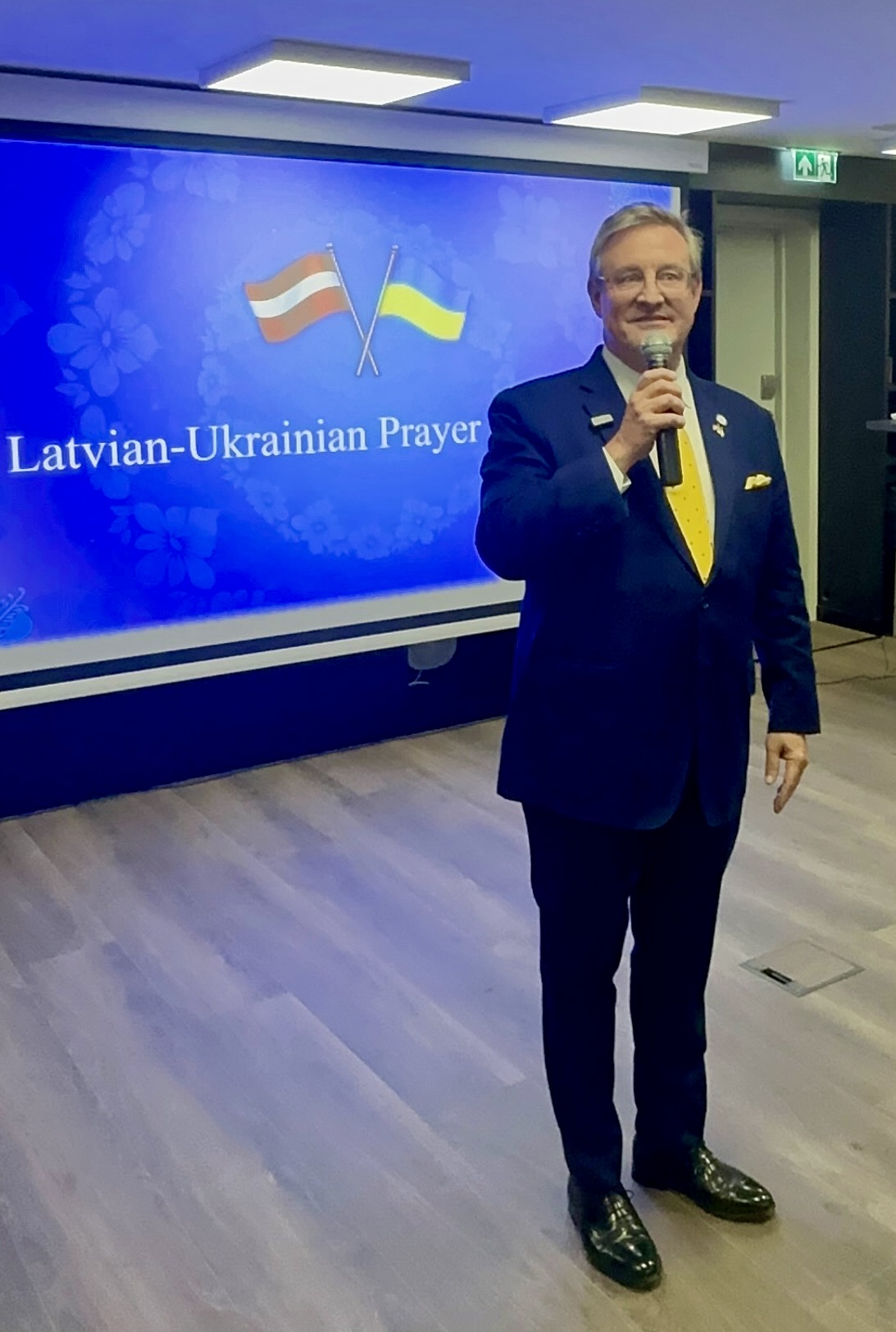

There was a great deal of discussion at the Sarajevo Security Conference about grey-zone warfare.
We heard about intelligence operations, cyberattacks, disinformation, infrastructure vulnerability, political interference and the increasingly blurred boundary between peace and war. Former intelligence officers were identified in the room. The serving professionals were, understandably, less conspicuous. Generals, diplomats, policymakers and analysts examined how hostile states operate below the threshold that would normally provoke a conventional military response.
The subject matters. Democracies that fail to understand grey-zone activity leave themselves open to manipulation, division and attack.
But over three days, I heard no other speaker make peace itself the subject.
In the Armed Forces Hall of Bosnia and Herzegovina, before an audience of senior military officers, diplomats and security specialists, I spoke instead about confidence.
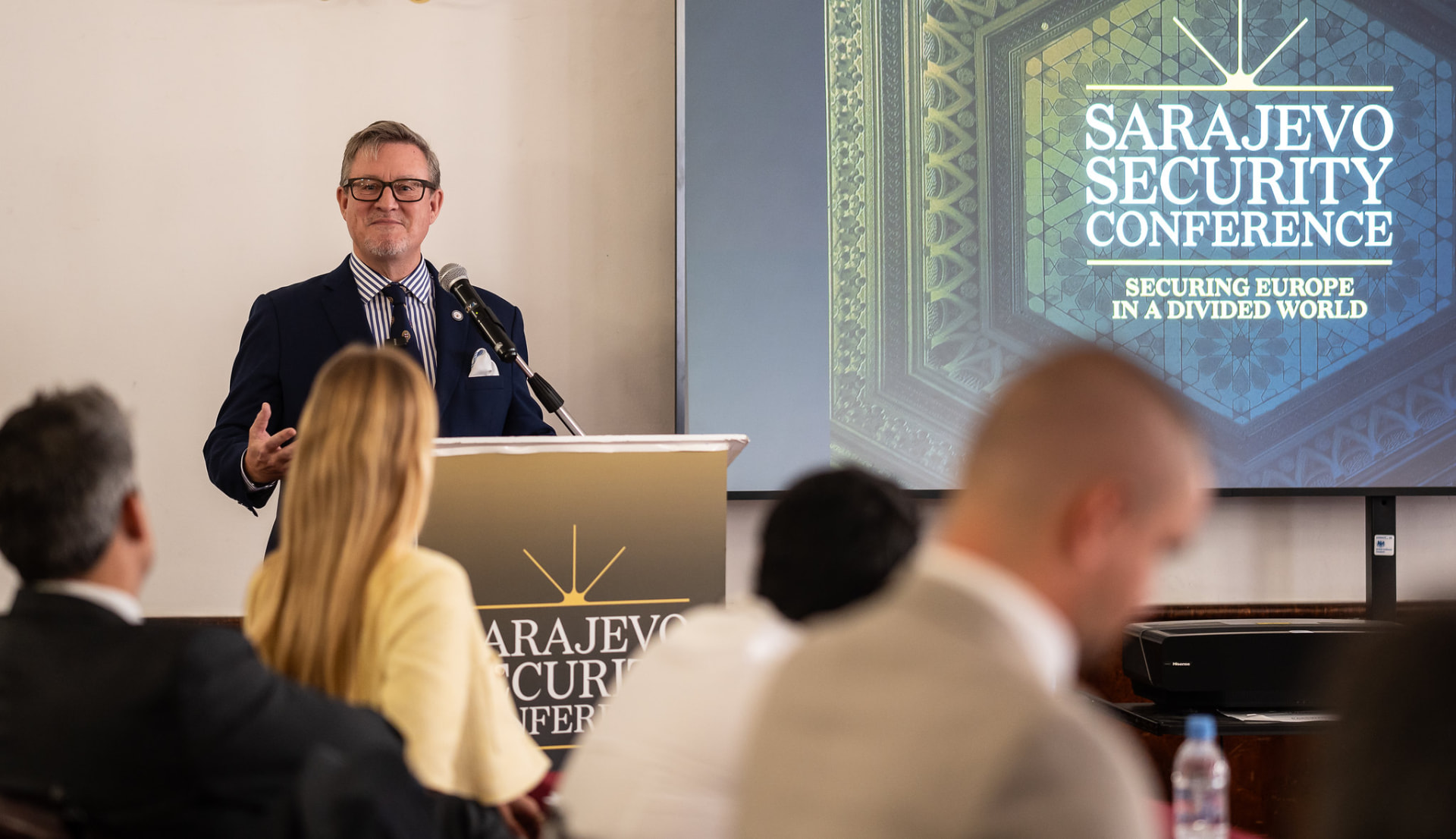
Not confidence as optimism. Not the belief that aggression can be answered with goodwill, or that deterrence can be replaced by dialogue. Bosnia has paid too high a price for such illusions. Ukraine is paying it now.
I spoke about confidence as part of the infrastructure of security.
That distinction matters because we often treat peace as the condition that follows war: first deter and defeat aggression, then negotiate an agreement, and only afterwards begin the work of peace.
Experience suggests otherwise.
If we wait for the moment of settlement before preparing societies for what follows, we will already be late.
We should not wait for peace to prepare for peace.
Beyond the diplomatic meaning of CBMs
Professional diplomats and security officials use the term confidence-building measures in a particular and important way.
CBMs may include military hotlines, inspections, verification procedures, exchanges of information, advance notification of exercises and direct communication intended to prevent misunderstanding or unintended escalation.
Those measures can save lives. When nuclear powers, military alliances or heavily armed neighbours misunderstand one another’s actions, a reliable telephone line may matter more than a room full of speeches.
But the Northern Ireland experience taught me that confidence-building reaches much further.
Our confidence-building measures were not confined to negotiations or security arrangements. They included investment, public spaces, economic development, culture, music and sport. They created reasons for people to meet before they agreed — and sometimes while they still profoundly disagreed.
We hosted Pavarotti. We used major sporting occasions. Van Morrison became, in his own way, an ambassador for a society beginning to recover confidence in itself.
None of this replaced policing, political negotiation or constitutional settlement. A concert cannot disarm a terrorist organisation. A sporting event cannot resolve competing claims of sovereignty.
But such things can help a divided society imagine itself differently.
They can create places in which people meet without first being required to settle the questions that divide them. They can loosen fear’s grip on public life. They can allow a society known internationally for violence to become associated with creativity, enterprise and possibility.
Investment can perform a similar role.
Capital as a confidence-building measure
Following the Northern Ireland peace process, I helped facilitate an initiative that brought together substantial American institutional investors, including New York public pension capital and funds representing teachers, firefighters and other public servants.
The resulting fund-of-funds structure, known as the Emerald Fund, sought to assemble a sizeable pool of capital capable of moving with greater speed than a succession of isolated investment decisions and of partnering alongside viable projects with both commercial potential and an impact upon a society emerging from conflict.
The particular vehicle did not become the permanent mechanism originally envisaged.
But the larger idea endured.
And one of the clearest demonstrations of that continuity has come from New York State.
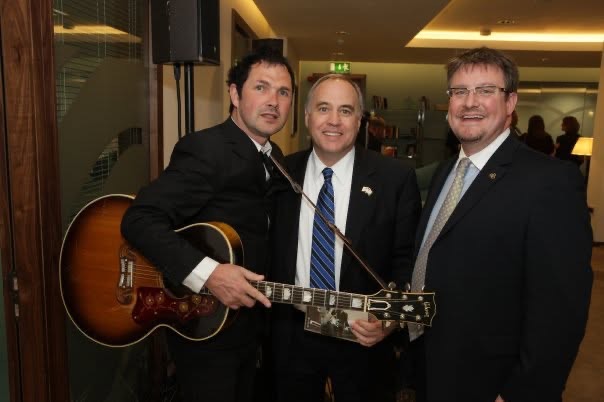
As Comptroller of the State of New York and sole trustee of the New York State Common Retirement Fund, Thomas P. DiNapoli has sustained a long-term investment relationship with Northern Ireland while remaining clear about the first duty of pension capital: it must produce appropriate returns for the people whose retirement savings are being invested.
That combination matters.
In 2014, the Common Retirement Fund committed $15 million to Belfast-based Crescent Capital. DiNapoli described Northern Ireland’s skilled workforce and infrastructure as characteristics capable of supporting long-term economic growth and providing a solid return to the pension fund.
Two years later, another $7 million was committed through the Bank of Ireland Kernel Capital Growth Fund to support growing Northern Ireland businesses.
Then, in Belfast in 2023, DiNapoli announced a further $50 million commitment to Northern Ireland companies. By then, the New York State Common Retirement Fund had committed almost $110 million to Northern Ireland private-equity investment since 2005.
That is not philanthropy.
It is investment.
And that distinction is central to the lesson.
DiNapoli has consistently presented the relationship in both fiduciary and societal terms: Northern Ireland has provided investment opportunities capable of producing returns for New York’s pensioners while investment has also supported employment across communities, economic growth and the peace process.
That is confidence-building capital in practice.
The importance lies not simply in the amount invested. It lies in the persistence of the relationship.
A pension fund responsible for the retirement security of more than a million people does not have the luxury of investing on sentiment. Capital has to survive due diligence. Businesses have to justify investment. Fund managers have to perform.
When such an institution returns repeatedly to a society once synonymous with political violence, the investment itself says something.
It says that transformation has become investable.
That message matters to local businesses considering expansion, international investors examining the region and families deciding whether their future still lies there.
Capital does not simply follow confidence.
Properly structured, it can help create confidence.
“Capital does not simply follow confidence. Properly structured, it can help create confidence.”
A Blue and Gold Fund for Ukraine
The lesson for Ukraine is not that Northern Ireland provides a model that can simply be copied.
The histories are different. The scale is different. The destruction is incomparably greater. The security environment is different, and Ukraine will carry the consequences of a major interstate war for generations.
But one principle travels.
Ukraine will require grants, sovereign finance, development-bank participation and direct investment on an enormous scale. It may also benefit from a dedicated investment architecture capable of bringing together institutional capital from the United States, the United Kingdom, the European Union and other allied nations.
It might appropriately be called the Blue and Gold Fund.
The name would identify the fund unmistakably with Ukraine, but its purpose would be practical: to assemble patient, credible capital before the moment at which opportunities are ready to receive it.
The Northern Ireland experience suggests something else.
The objective should not simply be to create a fund.
It should be to create an investment relationship capable of outliving any single fund.
That distinction is important.
The Blue and Gold Fund should not attempt to substitute private capital for public responsibility. Nor should it become another distant financing vehicle looking for distressed assets in a wounded country.
Its governance, investment criteria and partnerships would need to be developed with Ukrainians and aligned with Ukraine’s national and regional priorities. Investment decisions would need to withstand serious fiduciary scrutiny. Transparency and protection against political favouritism and corruption would have to be designed in from the beginning.
It could prepare to invest alongside public agencies, Ukrainian institutions, local authorities and responsible private partners in projects that are commercially viable and nationally useful.
Ports, railways, logistics centres, energy networks, housing, advanced manufacturing, digital infrastructure and the renewal of damaged communities could all fall within its field of interest.
The work of structuring such a fund, identifying institutional investors, agreeing safeguards and building a credible pipeline should begin before the war ends.
Capital assembled only after peace arrives may take years to deploy.
Capital prepared in advance can help turn the first opening into visible momentum.
A port can be a confidence-building measure.
A railway can be one.
A factory, a housing development or a functioning energy system can be one.
And a pension fund whose beneficiaries are thousands of miles away, but whose investment managers are prepared to stake capital on Ukraine’s future, can be one too.
Ukraine will require transformation, not merely reconstruction
Much of the present discussion about Ukraine understandably concentrates on military capability, security guarantees and reconstruction.
Each is necessary.
None is sufficient.
Reconstruction asks what must be rebuilt: homes, bridges, ports, railways, energy systems, hospitals and schools.
Post-conflict transformation asks a more difficult set of questions.
Will displaced families have the confidence to return?
Will investors believe that law, government and security arrangements are sufficiently reliable to risk capital over twenty or thirty years?
Will veterans and their families receive the support necessary to take part fully in national life?
Can communities carrying grief, anger and trauma resist those who will seek to turn their wounds into permanent political weapons?
Can public institutions earn trust while managing sums of reconstruction capital large enough to attract both legitimate enterprise and organised corruption?
Can people who have lived through occupation, bombardment, separation and bereavement imagine a future not governed by the war?
And, eventually, however distant or unwelcome the prospect may now appear, how will Ukrainians and Russians speak when speaking becomes necessary?
Nothing in that question excuses aggression or asks Ukraine to exchange justice for a superficial calm. Nor should preparation for peace be mistaken for an attempt to prescribe the timing or terms of a settlement. Ukrainians must retain agency over Ukraine’s future.
But wars end through some combination of military outcome, political exhaustion, negotiation and changed calculation. When that moment comes, political leaders will face decisions for which no society can prepare overnight.
Concrete can be poured relatively quickly.
Trust takes much longer.
“Concrete can be poured relatively quickly. Trust takes much longer.”
The courage that precedes confidence
Reconciliation is often discussed as though it were a gentle process.
It is not.
During the Northern Ireland peace process, I once found myself standing beside one of the principal protagonists in the conflict — someone whom many people I loved associated with years of violence.
A photograph appeared in the Belfast Telegraph and on the evening news.
My mother did not speak to me for a month.
I understood why.
Reconciliation can look, from a distance, remarkably like betrayal.
Meeting someone associated with killing, maiming or terror may require political courage, moral clarity and a willingness to be misunderstood by one’s own community.
Ukraine will face this in forms we cannot yet fully see.
People have lost husbands, wives and children. Soldiers have lost limbs. Families have lost homes. Towns have been occupied or destroyed. Children have grown up under air-raid warnings. A generation has been marked by war.
No conference language should sanitise that reality.
Yet durable peace will eventually require people to take steps before those steps are popular — perhaps before they are politically safe, and possibly before their own families understand.
Peace requires courage before it produces confidence.
That courage should not be demanded cheaply from those who have suffered. It should be prepared for carefully, supported institutionally and accompanied by justice, truth and credible security.
Europe’s strategic spine
Ukraine’s transformation will not stop at Ukraine’s borders.
It will involve the Baltic states, Poland and the Visegrád countries. It will draw upon Central Europe, the Western Balkans and the Black Sea region. Türkiye will matter, as will the routes extending towards the Caucasus.
For generations, Europe has usually been viewed from west to east.
Increasingly, we also need to see it from north to south:
From the Arctic and the Nordic nations, through the Baltic states and Poland; through Central Europe and the Visegrád region; into the Western Balkans and the Black Sea; and onward through Türkiye towards the Caucasus.
This is becoming Europe’s strategic spine.
Along it run ports, railways, energy systems, digital networks, defence industries and military-mobility corridors. These will help determine whether Europe can reinforce its eastern flank, sustain Ukraine, protect critical infrastructure and carry the commercial weight of reconstruction.
But the spine must carry more than matériel and money.
It must also carry relationships, institutional competence, political trust and shared purpose.
The countries closest to Ukraine understand the threat with an immediacy that cannot be reproduced in offices farther west. Many have direct experience of Soviet domination, Russian coercion or the unfinished business of Europe’s twentieth century. They also possess ports, transport networks, industrial capacity, cultural knowledge and personal relationships that will prove indispensable.
The Baltic states bring experience in resilience, digital government and resistance to disinformation. Poland will remain a principal logistical, political and economic gateway. The Visegrád and Central European nations possess manufacturing, energy and transport capacities that can connect Ukraine more closely to European markets. The Western Balkans carry hard-earned lessons about war, international intervention and the long distance between an agreement and a reconciled society.
This should not become another mechanism imposed upon Ukraine from outside.
It should be developed with Ukrainians, beginning with the question not merely of what others can build in Ukraine, but of what Ukraine and its neighbours can build together.
The Blue and Gold Fund could become one financial instrument within this larger strategic geography.
Capital from the United States, the United Kingdom, the European Union and other partners could be matched with opportunities in Ukraine and along the corridors that connect it to European and global markets.
The fund would therefore invest not only in isolated projects, but in the connections between them: the port and the railway serving it; the factory and its energy supply; the Ukrainian enterprise and its Central European markets.
Done properly, it could become confidence-building capital for Ukraine and the European spine on which Ukraine’s recovery will depend.
A pre-peace architecture
The work can begin without pretending that peace is imminent.
A serious pre-peace architecture would bring together Ukrainian national and municipal leaders, parliamentarians, businesspeople, churches and civic institutions with counterparts across Europe and North America.
It would identify the relationships and decisions that cannot wait:
Which ports, railways and border crossings will carry reconstruction materials and future trade?
Where will institutional capital meet credible, locally grounded projects?
How should the Blue and Gold Fund be structured, governed and protected from political favouritism and corruption?
Which American, British, European and other institutional investors should be invited to become its cornerstone participants?
What legal, insurance and risk-sharing arrangements will allow patient capital to participate?
How will Ukrainian municipalities develop the capacity to manage large programmes transparently?
What support will returning families and veterans require?
How can churches, schools, universities and civic organisations help repair the relationships that physical reconstruction cannot reach?
Which neighbouring countries are best placed to convene particular parts of this work?
How can the United States remain engaged without attempting to direct every European decision from Washington?
These are not postwar questions.
They are present questions about the conditions that will exist when an opening comes.
Government will be central, but government cannot do all of this. Business, institutional capital, philanthropy, faith communities, universities and civil society each hold pieces of the necessary architecture.
The work will need rooms in which people can speak before they are ready to negotiate.
It will need relationships that survive elections and changes of government.
It will need trusted intermediaries who understand Washington and Europe, security and commerce, public institutions and private capital.
And the experience of people such as Tom DiNapoli suggests that some of those relationships can begin with a simple but demanding proposition:
Find something worth investing in. Do the diligence. Put capital behind it. Stay.
Most of all, the work will require the discipline to begin without claiming to know when or how the war will end.
Security that can sustain peace
At Sarajevo, I argued that confidence-building must not be treated as the soft alternative to security.
Ukraine requires arms, resilient infrastructure and credible long-term security arrangements. A peace that merely gives an aggressor time to rearm is not durable peace. Srebrenica taught us what happens when an international declaration is not matched by the capability and will to honour it.
But military preparedness and confidence-building are not competing projects.
Deterrence can prevent aggression.
Defence can stop it.
Diplomacy can help end it.
Reconstruction can repair its damage.
Confidence is what allows people to risk building a future after it.
A security guarantee must be militarily credible. A reconstruction plan must be economically sound. The Blue and Gold Fund must be commercially disciplined. Institutions must be transparent and fit for purpose.
But a nation recovering from war also needs citizens willing to return, investors willing to remain, neighbours willing to cooperate and leaders able to disagree without turning difference once again into an existential struggle.
That work is slower than rebuilding a bridge and less visible than signing a treaty.
It may also determine whether the bridge and treaty survive.
Peace is never permanent.
Nor is conflict inevitable.
Both are built.
The question before us is whether we will begin building the foundations of Ukraine’s peace while there is still time to build them well.